
“Doubling your money isn’t magic—it’s math and patience.”
When it comes to personal finance and investing, many concepts can feel intimidating—especially when math is involved. Fortunately, some financial rules are designed to simplify complex ideas into easy-to-use shortcuts. One of the most popular and practical of these is the Rule of 72.
This simple rule helps you estimate how long it will take for your money to double given a fixed annual rate of return. Whether you’re a beginner investor or just trying to better understand interest rates, the Rule of 72 is a powerful mental math tool.
What Is the Rule of 72?
The Rule of 72 is a quick formula used to estimate the number of years required for an investment to double in value, assuming a constant annual rate of return.
The formula is:
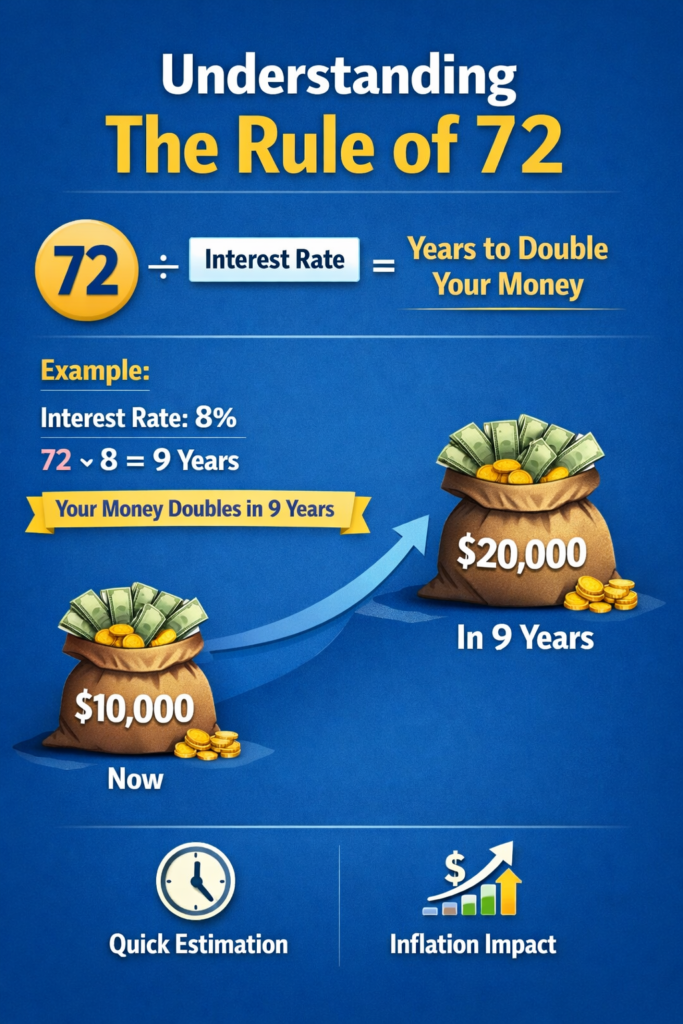
Years to Double = 72 ÷ Annual Rate of Return
That’s it. No calculator, spreadsheets, or complex equations required.
How the Rule of 72 Works (With Examples)
Let’s look at a few practical examples to see how it works in real life.
Example 1: 8% Annual Return
If you invest money at an average annual return of 8%:
72 ÷ 8 = 9 years
This means your investment will approximately double in 9 years.
Example 2: 6% Annual Return
72 ÷ 6 = 12 years
At a 6% return, your money doubles about every 12 years.
Example 3: 12% Annual Return
72 ÷ 12 = 6 years
Higher returns mean faster doubling—but usually with higher risk.
Why Is It Called the Rule of 72?
The number 72 is used because it has many divisors (2, 3, 4, 6, 8, 9, 12), which makes the math easy. More importantly, 72 provides a surprisingly accurate estimate for compound interest rates typically seen in investing—generally between 4% and 12%.
While it’s not mathematically perfect, it’s close enough for quick decision-making and financial planning.
The Power of Compounding
The Rule of 72 highlights one of the most important concepts in finance: compound interest.
Compounding means you earn returns not only on your original investment, but also on the returns you’ve already earned. Over time, this creates exponential growth.
For example:
$10,000 invested at 8% becomes ~$20,000 in about 9 years
In another 9 years, it becomes ~$40,000
Time, not just return, is a critical factor. This is why starting early matters so much.
Using the Rule of 72 for Inflation
The Rule of 72 doesn’t just apply to investments—it also works for inflation.
If inflation averages 3% per year:
72 ÷ 3 = 24 years
This means the cost of goods will double roughly every 24 years. In other words, what costs $50 today may cost about $100 in 24 years.
Understanding this helps explain why long-term investing is essential to preserving purchasing power.
Limitations of the Rule of 72
While useful, the Rule of 72 has some limitations:
It assumes a constant rate of return, which rarely happens in real markets
It’s less accurate at very low (below 3%) or very high (above 15%) interest rates
It doesn’t account for taxes, fees, or contributions over time
Think of it as a rule of thumb, not a precise forecasting tool.
Why the Rule of 72 Matters
The Rule of 72 is valuable because it:
Makes investing concepts easy to understand
Helps compare different investment options quickly
Reinforces the importance of time and compounding
Encourages long-term thinking instead of short-term speculation
If you can estimate how fast your money can grow—or lose value—you’re better equipped to make smarter financial decisions.
Final Thoughts
Finance doesn’t have to be complicated to be effective. The Rule of 72 is proof that a simple idea can deliver powerful insight. By understanding how long it takes for money to double—or prices to rise—you gain a clearer picture of the impact of interest, inflation, and time.
Whether you’re saving for retirement, investing for the future, or just learning the basics, mastering the Rule of 72 is a great step toward financial confidence.
Disclaimer: This article is for educational purposes only and does not constitute financial advice.